
The two sides are also expected to finalise a roadmap for restoration of peace and tranquility in the high-altitude region that witnessed an eight-week bitter standoff between the troops of the two countries.
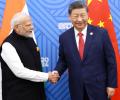
Chinese Foreign Minister Wang Yi said on Friday that India-China relations have made positive strides and achieved a series of encouraging outcomes at all levels after last year's breakthrough ending the over four-year-long military standoff in eastern Ladakh. Wang's remarks came during his annual press conference as he replied to a question on how Beijing views the course of bilateral ties after the two countries ended the prolonged stalemate in the ties.

A start-up firm in Noida said soon after the Galwan Valley clash, it was tasked by the Indian security forces to provide them equipment to be able to tackle the Chinese and they have provided them solutions in the form of non-lethal weapons inspired by the traditional Indian weapons like the 'Trishul' of Lord Shiva.
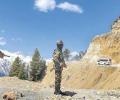
In the next few days, Indian Army will carry out a detailed verification to check actual implementation of the disengagement process, he said. It is learnt that the mutual disengagement in Gogra (patrolling point 17A) is expected to be completed by Thursday.
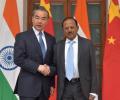
'Both sides had candid and in-depth discussions over easing the current border situation and reached positive common understandings,' it said. 'Both sides welcomed the progress achieved in the recent military and diplomatic meetings, agreed to stay in dialogue and consultation, and stressed the importance to promptly act on the consensus reached in the commander-level talks between Chinese and Indian border troops, and complete disengagement of the front-line troops as soon as possible,' it said.

The meeting comes against the backdrop of demands by the opposition seeking details of the violent face-off between Indian and Chinese troops in the Galwan Valley in Ladakh which left 20 Indian Army personnel dead.

Prime Minister Narendra Modi and Chinese President Xi Jinping will hold bilateral talks on Wednesday on the margins of the Brazil, Russia, India, China, South Africa (BRICS) summit in Russia, in their first structured meeting since the eastern Ladakh border row erupted in May 2020.

The Chinese have been objecting to the presence of Indian Navy ships in the region where it has significantly expanded its presence since 2009 through artificial islands and military presence.
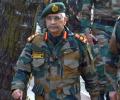
Gen Naravane reviewed the overall security situation in the region with Northern Army Commander Lt Gen Yogesh Kumar Joshi, commander of the 14 Corps Lt Gen Harinder Singh and other senior Army officials.

Weidong said India and China "should live in peace and avoid conflicts."
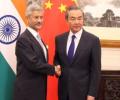
Wang said the two sides should follow the important consensus reached by the leaders of the two countries and strengthen the communication and coordination on the proper handling of the border situation through the existing channels so as to jointly maintain peace and tranquility in the border area, the Chinese foreign ministry said in a statement.

Chinese foreign ministry spokesman Geng Shuang told a media briefing in Beijing that "at the moment the situation in the boundary region between China and India is overall stable and controllable".
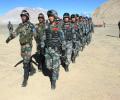
Sources said that after the June 6 talks between Military commanders followed by other rounds of talks, there has not been any considerable build-up activity by both sides and Chinese aggressive behaviour has also been toned down, they said.

The resolution was introduced by Senator John Cornyn, Republican Senate Majority Whip, and Senator Mark Warner, ranking member of the Senate Select Committee on Intelligence.
The marathon fourth round of Lt Gen-level talks also focussed on steps for pulling back large number of troops and weapons from rear bases along the Line of Actual Control in eastern Ladakh.

Chinese Foreign Minister Wang Yi has expressed readiness to join hands with India's National Security Advisor Ajit Doval to "properly handle" issues related to the situation on the ground in the border areas, amid the protracted border row in eastern Ladakh.
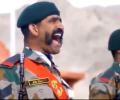
The video comes just days after 20 Indian soldiers lost their in a "violent face-off" with Chinese troops in the LAC across Galwan Valley of Ladakh.

China has violated border agreements, External Affairs Minister S Jaishankar said on Tuesday, noting that continued tension will cast a natural shadow over the rest of this relationship.
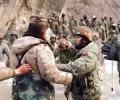
Some may see China's decision to antagonise India as strategically unwise. But China believes its prestige demands standing up to India, whatever the cost.
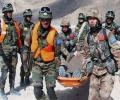
This is the first such incident along the border with China that Indian armed forces personnel have been killed after a gap of nearly 45 years.
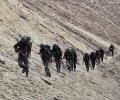
The government needs to answer the critical question of whether it has accepted any restrictions on its infrastructure creation activities, asserts Ajai Shukla.

Families spread across the nation bid their final goodbyes to the soldiers killed in hand-to-hand fighting with Chinese troops in Ladakh's Galwan area. People gathered in large numbers to attend the last rites of the soldiers.

From rescuing tiger cubs to rescuing a crocodile to admiring spring in Kashmir, here are some interesting videos for your viewing pleasure.
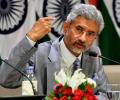
Chinese Foreign Minister Wang Yi and his Russian counterpart Sergei Lavrov will be the other two participants at the conference. Uncertainty had loomed over the meeting following the cross border clash between Indian and Chinese troops in Galwan Valley on Monday evening.
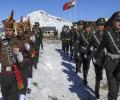
The focus of the deliberations was on finalising modalities for disengagement of troops in eastern Ladakh.
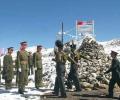
At the talks, the Indian side insisted on complete disengagement of Chinese troops at the earliest and immediate restoration of status quo ante in all areas of eastern Ladakh prior to May 5 when the standoff began following a clash between the two armies in Pangong Tso, they said.

The navy has significantly expanded its deployment in the Indian Ocean Region deploying a plethora of warships and submarines to create pressure points on China as the maritime space around the Malacca Strait is very critical for its supply chain through sea routes.

The next phase of the de-escalation process will kick off only after the fourth round of talks between corps commanders of the two sides.
The two militaries are set to hold extensive talks on finalising modalities for restoring normalcy and bringing back peace and tranquillity in the region after the verification of the disengagement exercise is completed.

The new guidelines, effective from August 1, aim to expedite visa approvals for nationals from China and other countries sharing land borders with India.
Sources said the process of disengagement along the Line of Actual Control is "complex", and in such a context, speculative and unsubstantiated reports need to be avoided.

The father of late Colonel Santosh Babu on Monday said he was 'not 100 per cent satisfied' with the Mahavir Chakra posthumously awarded to him for his acts of gallantry against the Chinese attack in Galwan Valley in eastern Ladakh in June 2020, and that he should have been honoured with the Param Vir Chakra.

The two sides held diplomatic talks through video conference on the border standoff in midst of fresh details emerging that China has strengthened its position in several areas in eastern Ladakh including Galwan Valley where a violent clash on June 15 left 20 Indian soldiers dead.
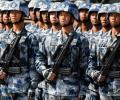
Chinese military has also deployed a sizeable number of its troops in Galwan Valley, the site of the violent clashes on June 15 that left 20 Indian soldiers dead.
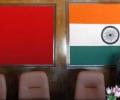
India and China have agreed to take measures to further ease the situation at the borders while continuing to implement the October agreement to resolve the standoff in eastern Ladakh comprehensively. The two sides held the 32nd meeting of the Working Mechanism for Consultation & Coordination on China-India Border Affairs (WMCC) in New Delhi, agreeing to maintain communication through diplomatic and military channels and safeguard sustainable peace and stability in the border areas. This meeting follows the October 21 agreement between the two countries to resolve the over four-year-long military standoff in eastern Ladakh.
The Indian side is expected to present specific proposals at the talks to deescalate tension in Pangong Tso, Galwan Valley and Demchok -- the three areas in eastern Ladakh where the two sides have been on a bitter standoff for last one month, the sources said.
China and India were able to "reduce differences" and build "some consensus" on disengaging troops from friction points to end the standoff in eastern Ladakh and agreed to maintain dialogue to reach a resolution acceptable to both sides at an "early date", the Chinese defence ministry said on Thursday.
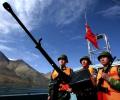
The Chinese side has particularly bolstered its presence in the Galwan Valley, erecting around 100 tents in the last two weeks and bringing in heavy equipment for construction of bunkers, notwithstanding the stiff protest by Indian troops. There have been reports of multiple incidents of transgressions by Chinese troops in several areas in Eastern Ladakh.

The Indian Army is one of the very few armies in the world that operates tanks at high altitudes up to 16,000 feet, and in large numbers.

The situation along the Line of Actual Control (LAC) in eastern Ladakh is stable but sensitive and not normal, Chief of Army Staff General Upendra Dwivedi said on Tuesday on the dragging military standoff between China and India in the region.
